

Having trouble loading a project?If a project is stuck loading, showing a “This is taking longer than normal” message, or won’t open at all, try the steps in our dedicated troubleshooting guide: Project won’t load or open.
Try the basics: Reload or restart
Try the basics: Reload or restart
If you’re experiencing strange or non-reproducible issues:
- Reload the project. In a web browser, click the
Refresh button or use the Command/Ctrl +
R shortcut. In the desktop app, use the keyboard shortcut
Shift + Cmd/Ctrl + Ror select Window > Reload from the main application menu. - Restart your computer
Missing visuals or audio
Missing visuals or audio
Missing visuals?
- Check if script or media layers are hidden in the Layer list in the Properties panel. Learn more about Layer visibility and order.
- Switch to a video composition if needed.
- Check if a layer is solo’d in the Layer list of the Properties panel.
- If you’re a Windows user, verify Exclusive Mode is disabled.
How to disable Exclusive Mode (Windows only)
Exclusive Mode in Windows sound settings can prevent multiple apps from using your audio devices at the same time. Disabling it may resolve audio issues.- Right-click the speaker icon in your taskbar and select Sound Settings.
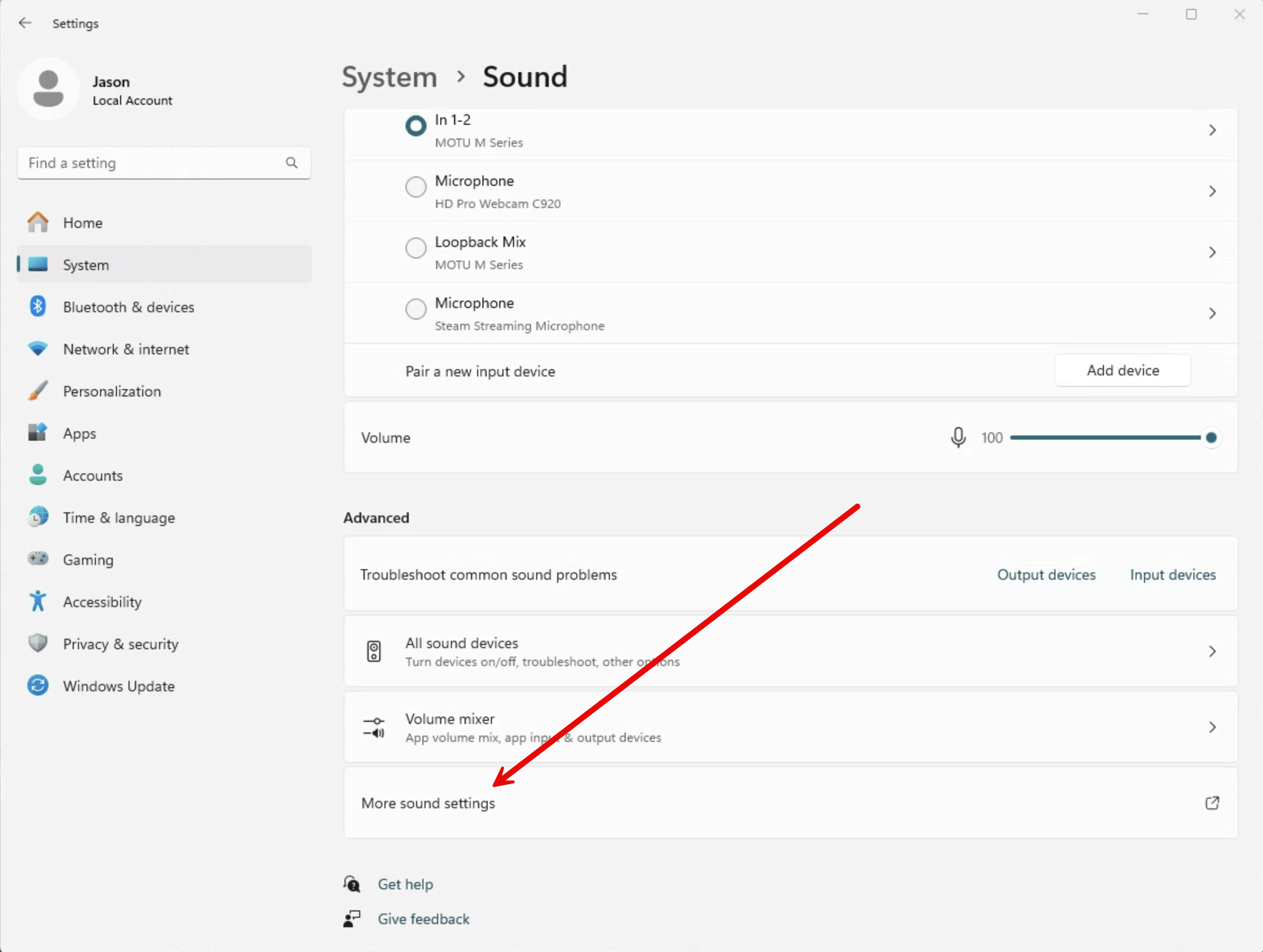
- Scroll down and select More sound settings.\
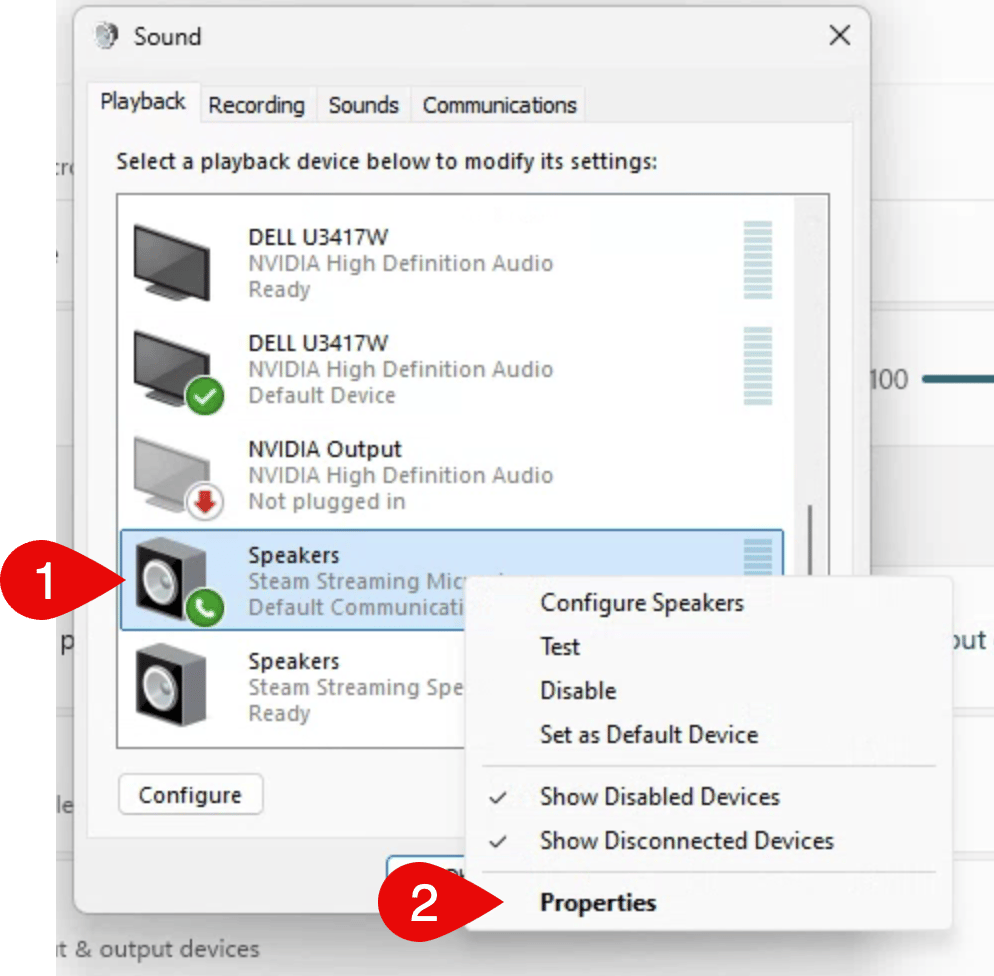
- In the new window, under Playback,
right-click your output device and select
Properties.\
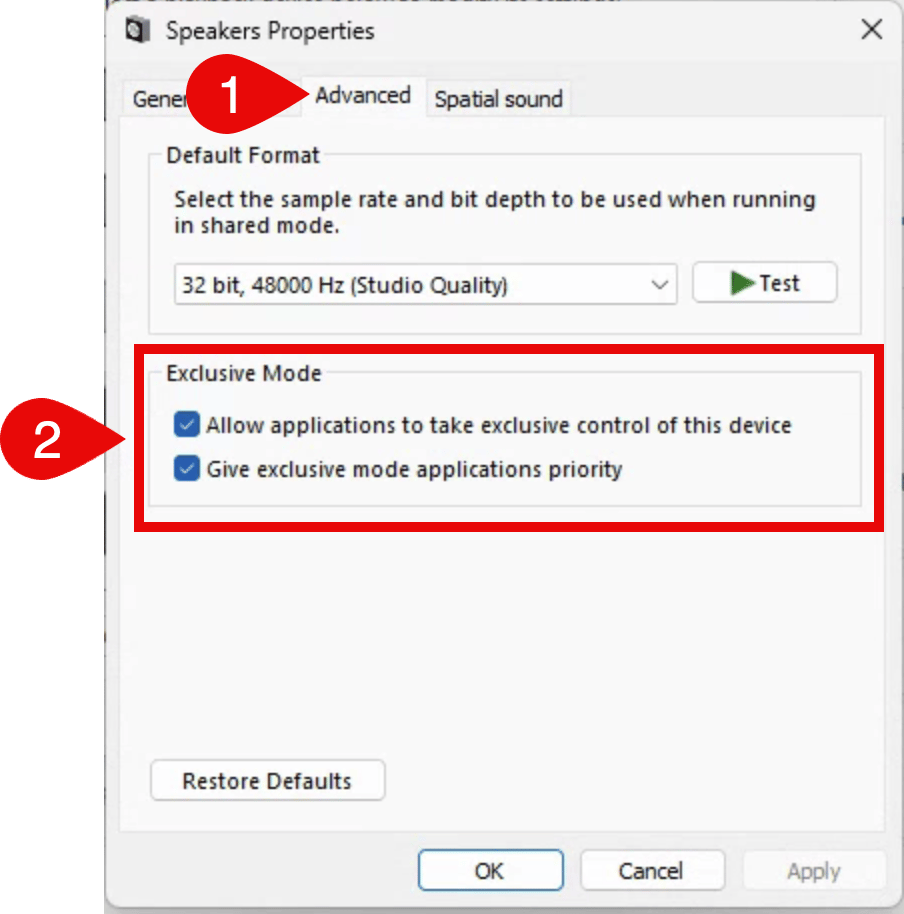
- Navigate to the Advanced tab.
- Uncheck the boxes related to Exclusive Mode.\
- Click Apply and then OK to save your changes.
How to disable Exclusive Mode (Windows only)
How to disable Exclusive Mode (Windows only)
Exclusive Mode in Windows sound settings can prevent
multiple apps from using your audio devices at the
same time. Disabling it may resolve audio issues.
- Right-click the speaker icon in your taskbar and select Sound Settings.
- Scroll down and select More sound settings.\
- In the new window, under Playback,
right-click your output device and select
Properties.\
- Navigate to the Advanced tab.
- Uncheck the boxes related to Exclusive Mode.\
- Click Apply and then OK to save your changes.
Reduce project size and complexity
Reduce project size and complexity
Projects with several GBs of files, long compositions, or lots of
edits can slow things down. If you’re seeing performance issues,
try breaking your work into smaller compositions or separate projects.
There’s no one-size-fits-all rule — your device specs also play a
big role — but if things start lagging as your project grows, this
could be the reason.
Learn how to copy a composition to a different project.
Close other apps
Close other apps
Closing high-usage apps like web browsers or video conferencing tools
can help free up memory and improve Descript’s performance. Even
background apps can make a difference — close anything you’re not
actively using.
Free up hard drive space
Free up hard drive space
Descript runs best when your device has at least 20GB of free disk
space.
Free up space on Mac
|
Free up space on Windows
Check your system requirements
Check your system requirements
For the best experience, your device should meet (or exceed!) our
recommended system specs. If you’re running into slowdowns, crashes,
or export issues, double-checking your hardware is a good place to
start.
View system requirements
Disable Grammarly or other writing assistant extensions
Disable Grammarly or other writing assistant extensions
Extensions that interact with text — like Grammarly or other script-reading
tools — can interfere with Descript and affect performance.
How to disable Grammarly
|
Disable Chrome extensions
Disable McAfee antivirus (or add an exception)
Disable McAfee antivirus (or add an exception)
We’ve seen reports that McAfee can interfere with Descript’s performance.
If you’re noticing lag or instability, try disabling McAfee while
you work — or add Descript as an exception to avoid conflicts.
How to disable McAfee
Use the fastest GPU on your machine
Use the fastest GPU on your machine
Descript currently supports one GPU at a time. If you’re on a machine
with both integrated and discrete GPUs, make sure Descript is using
the high-performance option.
Set default GPU on macOS
- Open Activity Monitor and navigate to Window > GPU History.
- Start exporting a composition.
- See which GPU is being used. If it’s not the discrete one (like AMD), turn off Automatic Graphics Switching in Energy settings.
Set default GPU on Windows
- Open Task Manager (Ctrl+Alt+Delete) and go to the Performance tab.
- Start exporting a composition.
- Check which GPU is being used. If needed, change it in your GPU settings.
Switch to the dedicated NVIDIA GPU
- Open the NVIDIA Control Panel.
- Go to 3D Settings > Manage 3D settings.
- Under Program Settings, select Descript.
- Choose High-performance NVIDIA processor as the preferred GPU.
- Save your changes.
Switch to the dedicated AMD GPU
- Open AMD Radeon Settings from your desktop context menu.
- Go to System > Switchable Graphics.
- Find Descript in the app list and set it to High Performance.
Force software video decoding (Windows)
Force software video decoding (Windows)
If you’re on Windows and experiencing persistent playback issues
(some symptoms are a blank scene editor, an endlessly spinning
play button, or disappearing visuals)—your system may be having
trouble with hardware-based video decoding.In most cases, playback will work briefly after restarting Descript,
but the problem returns after a few minutes or when switching
between projects.Enable Force software video decoding in your
Descript app settings,
then fully quit the app by clicking the Descript D icon in your
menubar and selecting Quit Descript Completely.
Reopen Descript to apply the change.
When toggled on: Descript bypasses your GPU
and uses your processor (CPU) to decode video. This can reduce
visual bugs and playback stalls, especially on systems with Intel
Arc graphics or other GPU compatibility issues.
Error during playback
Error during playback
Occasionally, files with an unsupported or invalid format trigger a playback error. Descript detects and repairs many of these issues automatically.When Descript detects a problem with a file, it displays a warning badge indicator next to the file in your Project panel. To repair the file:
- Right-click the file in the Project panel.
- Select Fix file issue. This option only appears when Descript detects an issue.
- Review the detected issues and click Repair file.
Incompatible browser or device error when using Chrome
Incompatible browser or device error when using Chrome
If you see this message when using Chrome (which is a supported
browser), please navigate to
chrome://settings/system
and toggle ON use graphics acceleration when possible.