> ## Documentation Index
> Fetch the complete documentation index at: https://help.descript.com/llms.txt
> Use this file to discover all available pages before exploring further.
# Layer and Clip Overview
> Layers contain all the visual and audio elements in your Descript project—video, images, text, music, and sound effects.
Everything you see or hear in a project lives on a layer, stacked and timed independently of the script track. Layers are how you arrange the visuals and audio around your transcript.
**Not seeing a transcript?**
Layers are not part of the transcribed script track. If you want your media to be transcribed, you'll need to add it to the script track. [Learn how the script track works](/script-editing/speakers).
## Layers and clips explained
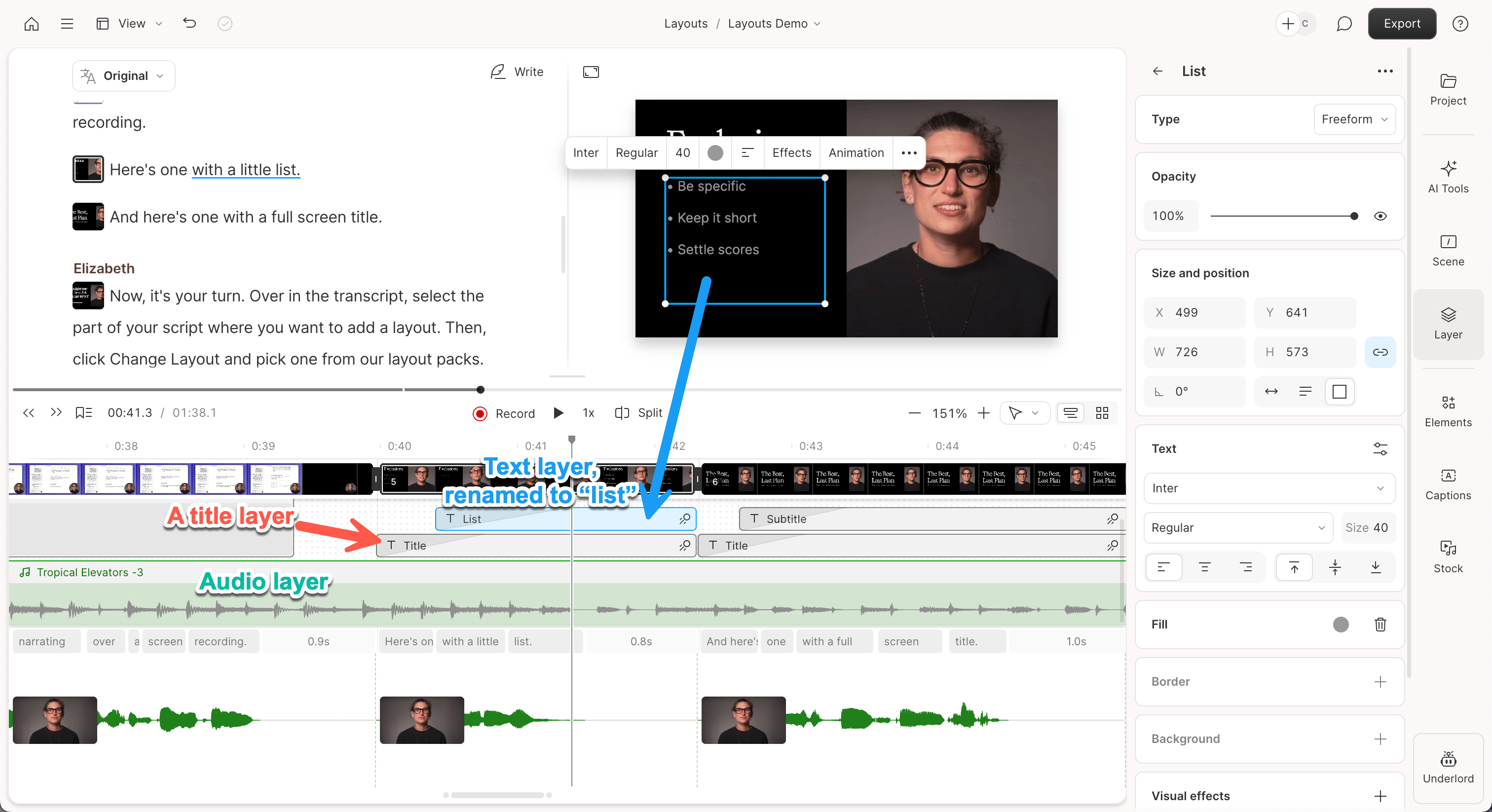 **Layers** are containers for all visual and audio elements in your project. You can stack them, reposition them, and control how they appear across scenes.
**Clips** only exist within audio and video layers. Splitting a media layer creates clips—segments you can edit independently.
**Non-media layers** (text, images, shapes) don't contain clips. Splitting these creates duplicate layers instead.
## How to work with clips and layers
### Trim a clip or layer
Adjust where a clip or layer starts and/or ends without deleting the underlying media by manually adjusting it via the timeline.
1. First, select the layer in your scene editor.
2. Hover your mouse over the edge of any clip or layer in the timeline.
3. When the cursor changes to a small handle, click and drag to trim.
### Split a clip or layer
Splitting divides a clip into separate segments at the playhead position, letting you isolate and adjust different parts of your media.
1. Position the playhead where you want to split.
2. Press **Cmd+Shift+S** (Mac) or **Ctrl+Shift+S** (Windows).
**Layers** are containers for all visual and audio elements in your project. You can stack them, reposition them, and control how they appear across scenes.
**Clips** only exist within audio and video layers. Splitting a media layer creates clips—segments you can edit independently.
**Non-media layers** (text, images, shapes) don't contain clips. Splitting these creates duplicate layers instead.
## How to work with clips and layers
### Trim a clip or layer
Adjust where a clip or layer starts and/or ends without deleting the underlying media by manually adjusting it via the timeline.
1. First, select the layer in your scene editor.
2. Hover your mouse over the edge of any clip or layer in the timeline.
3. When the cursor changes to a small handle, click and drag to trim.
### Split a clip or layer
Splitting divides a clip into separate segments at the playhead position, letting you isolate and adjust different parts of your media.
1. Position the playhead where you want to split.
2. Press **Cmd+Shift+S** (Mac) or **Ctrl+Shift+S** (Windows).
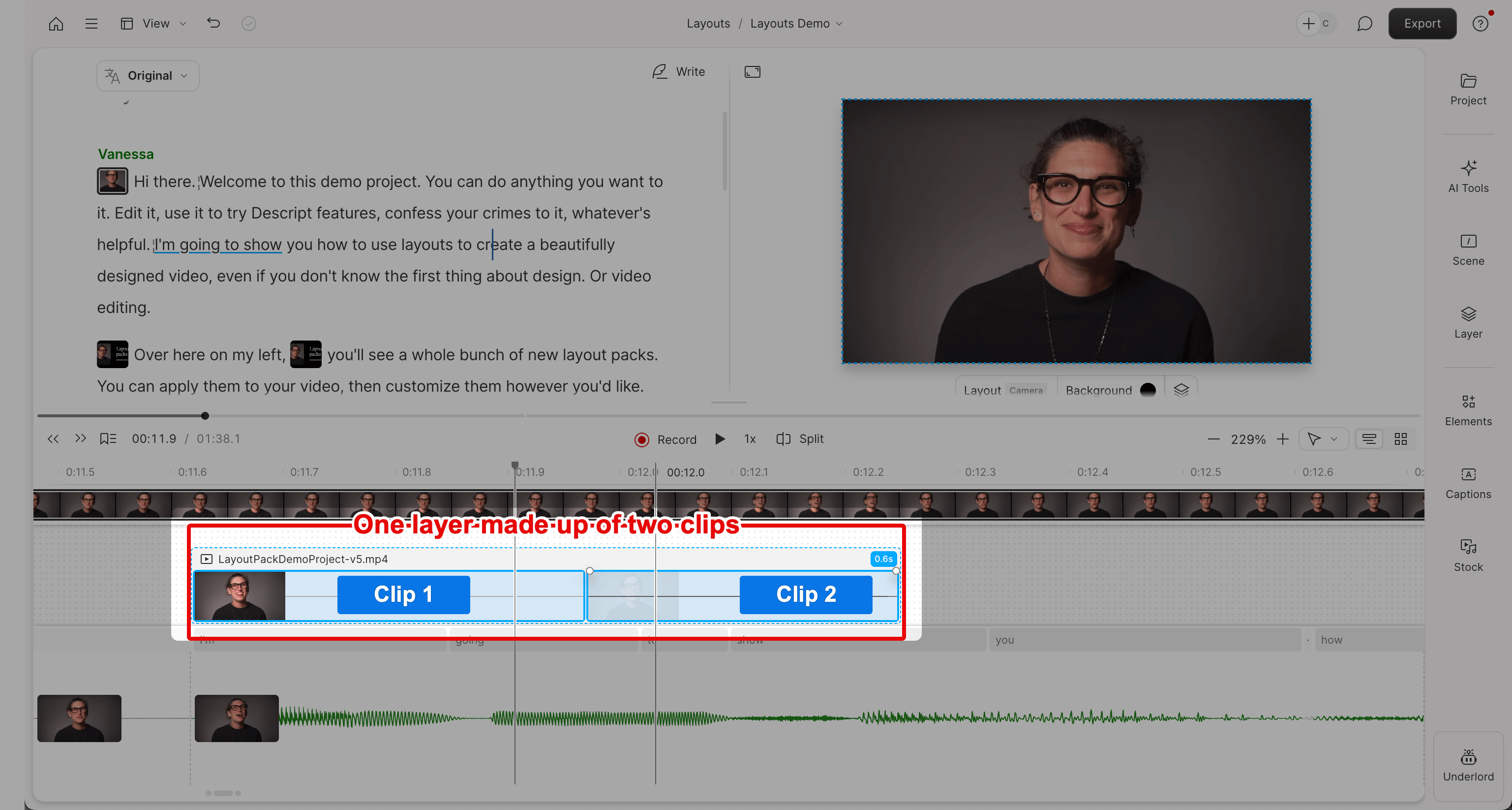 For non-media layers (like text or shapes), splitting creates two independent layers that you can reposition or edit separately.
### Copy and paste behavior
When you paste a layer, Descript tries to maintain the original offset from the start of the scene you copied it from. This preserves layer timing when moving content between scenes.
If the playhead is in a scene long enough to fit that offset, the layer pastes at the same relative position within the scene. If the destination scene isn't long enough, the layer may not paste or may paste at a different position than expected.
## Types of layers in Descript
You can add any of these layer types to your composition:
* Video, audio, and images
* [Shapes](/visuals/shapes)
* [Waveforms](/visuals/waveforms)
* [Progress bars](/visuals/progress-bars)
* [Text, emojis, and captions](/visuals/text-layers)
* [Avatars](/generative-media/overview)
## What's next
Once you understand how layers work, you're ready to start adding them to your composition. You can add video, images, text, and more using the **Add Layer** button or by dragging media from the Project panel.
[Learn how to add layers in Descript](/visuals/add-layer)
For non-media layers (like text or shapes), splitting creates two independent layers that you can reposition or edit separately.
### Copy and paste behavior
When you paste a layer, Descript tries to maintain the original offset from the start of the scene you copied it from. This preserves layer timing when moving content between scenes.
If the playhead is in a scene long enough to fit that offset, the layer pastes at the same relative position within the scene. If the destination scene isn't long enough, the layer may not paste or may paste at a different position than expected.
## Types of layers in Descript
You can add any of these layer types to your composition:
* Video, audio, and images
* [Shapes](/visuals/shapes)
* [Waveforms](/visuals/waveforms)
* [Progress bars](/visuals/progress-bars)
* [Text, emojis, and captions](/visuals/text-layers)
* [Avatars](/generative-media/overview)
## What's next
Once you understand how layers work, you're ready to start adding them to your composition. You can add video, images, text, and more using the **Add Layer** button or by dragging media from the Project panel.
[Learn how to add layers in Descript](/visuals/add-layer)