> ## Documentation Index
> Fetch the complete documentation index at: https://help.descript.com/llms.txt
> Use this file to discover all available pages before exploring further.
# Convert AI Speech to a Standard Audio Layer
> Unlock timeline-style editing for AI speech by converting it to a standard audio layer.
AI speech behaves differently from recorded audio until you convert it. Turn it into a standard audio layer to edit it the normal way.
**Conversion is permanent**
Once you convert AI speech to audio, you can't edit the underlying text or regenerate from the script. To change what the voice says, delete the converted audio and [generate new AI speech](/ai-speech/tts) from the script.
## Why convert AI speech
AI voice clips behave differently from recorded audio. Until you convert, you can't:
* Adjust [word boundaries](/script-editing/the-wordbar)
* Edit the clip directly in the [timeline](/timeline/timeline-tools)
* Apply trims, fades, or crossfades
* Get precise control over playback and alignment
Converting turns AI speech into a standard audio layer so all of those tools work on it.
## Convert AI speech
You can convert AI speech from the script or from the timeline. Both produce the same result.
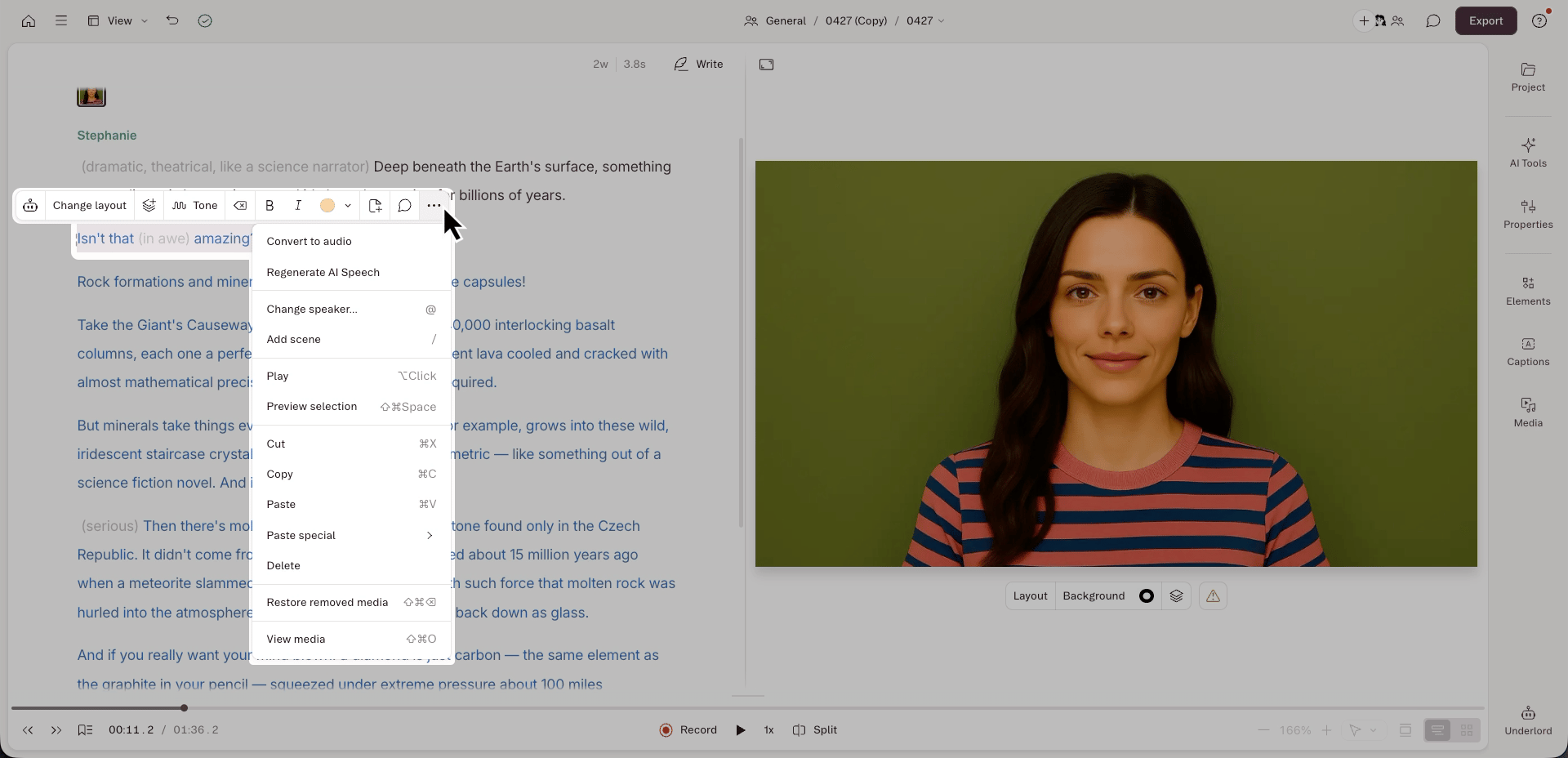
### From the script
1. Select the AI speech text in your script.
2. Click the ellipsis (**…**) icon in the hover menu.
3. Select **Convert to audio**.
 ### From the timeline
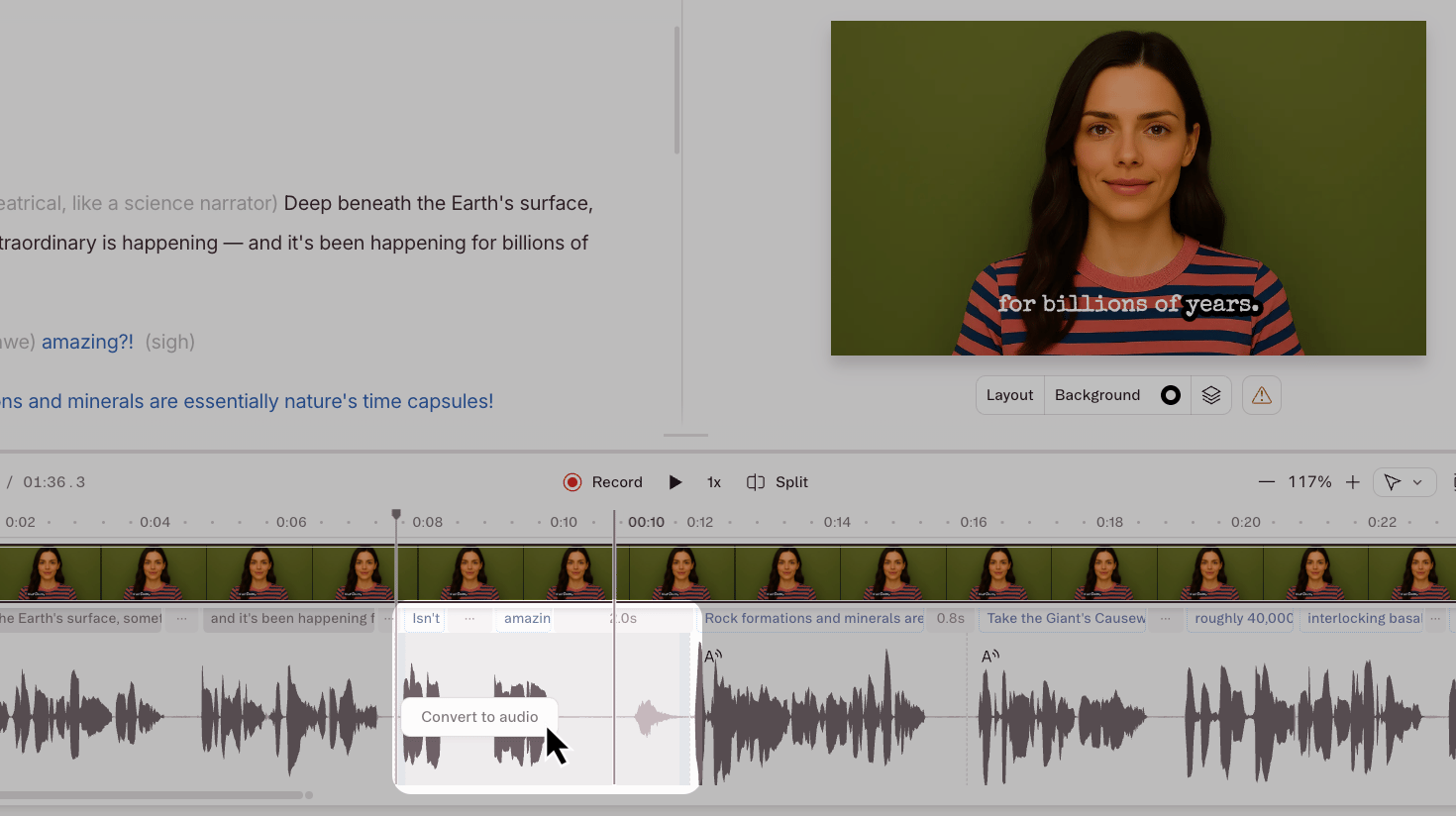
1. Hover over the AI voice clip in the timeline.
2. Click **Convert to audio**.
### From the timeline
1. Hover over the AI voice clip in the timeline.
2. Click **Convert to audio**.
 ## What changes after you convert
Once converted, the clip behaves like any other recorded audio layer. A few things to know:
* **The text stays in your script** as a transcript of the converted audio. Editing it won't change the audio — you'd need to delete the converted clip and generate new AI speech instead.
* **AI Speaker controls disappear** for the converted clip. You can't change the voice, regenerate, or [direct delivery with tone tags](/ai-speech/tts#direct-ai-voice-performance-with-tone-tags).
* **Existing tone tags become regular** **[inline notes](/getting-started/edit-like-a-doc).** Any parenthesized tags in your script (like `(serious)` or `(sigh)`) stop directing AI delivery and become plain text annotations. They're safe to delete without affecting the converted audio.
## FAQs
Yes, immediately after converting — use `Cmd + Z` (Mac) or `Ctrl + Z` (Windows), or restore from [version history](/working-in-projects/version-history). Once you've moved on, conversion is effectively permanent. To change what the voice says, delete the converted audio and generate new AI speech from the script.
Yes. Select only the text you want to convert, then use the ellipsis menu to convert. The rest of the paragraph stays as AI speech.
The clip may already be a standard audio layer, or you may not have selected AI speech text. Confirm the text is highlighted and assigned to an AI Speaker before opening the hover menu.
## What changes after you convert
Once converted, the clip behaves like any other recorded audio layer. A few things to know:
* **The text stays in your script** as a transcript of the converted audio. Editing it won't change the audio — you'd need to delete the converted clip and generate new AI speech instead.
* **AI Speaker controls disappear** for the converted clip. You can't change the voice, regenerate, or [direct delivery with tone tags](/ai-speech/tts#direct-ai-voice-performance-with-tone-tags).
* **Existing tone tags become regular** **[inline notes](/getting-started/edit-like-a-doc).** Any parenthesized tags in your script (like `(serious)` or `(sigh)`) stop directing AI delivery and become plain text annotations. They're safe to delete without affecting the converted audio.
## FAQs
Yes, immediately after converting — use `Cmd + Z` (Mac) or `Ctrl + Z` (Windows), or restore from [version history](/working-in-projects/version-history). Once you've moved on, conversion is effectively permanent. To change what the voice says, delete the converted audio and generate new AI speech from the script.
Yes. Select only the text you want to convert, then use the ellipsis menu to convert. The rest of the paragraph stays as AI speech.
The clip may already be a standard audio layer, or you may not have selected AI speech text. Confirm the text is highlighted and assigned to an AI Speaker before opening the hover menu.